Hair Oil for Hair Fall: 6 Oils That Help (and When Oil Is Not Enough)
The best hair oil for hair fall depends on why your hair is falling. If your hair is snapping and breaking, a nourishing oil such as coconut oil or a desi ghee herbal blend can cut that breakage down. If your hairline or crown is slowly thinning, rosemary oil has the best evidence of any oil. But if your hair is shedding from the root after a fever, a baby, stress or low iron, no oil on its own will fix it.
That is the honest answer most hair oil ads skip. At Velvet Touch, a Lahore-based hair and skin care brand, hair fall is the number one question our customers ask. This guide explains what is normal, what causes hair fall in Pakistan, which oils actually help, how to use them, and when you should stop oiling and see a doctor.
Key Takeaways
- Losing 50 to 100 hairs a day is normal. Worry when you see clumps, patches or a widening parting.
- First check if it is breakage (short broken pieces) or shedding (full hairs with a small white bulb). Oil helps breakage most.
- Rosemary oil matched 2% minoxidil for early pattern thinning in one 6-month trial. Coconut oil reduces protein loss from hair.
- Oil 2 to 3 times a week, massage the scalp for 3 to 5 minutes, and wash out within a few hours if you have dandruff.
- In Pakistan, low iron, low vitamin D, thyroid problems, PCOS and post-dengue or post-typhoid shedding are common causes. Get a blood test if hair fall lasts more than 3 months.
- Give any oil routine at least 8 to 12 weeks before you judge it.
Quick Answer: Which Oil Is Best for Hair Fall?
Here is a short comparison. The details for each oil are further down.
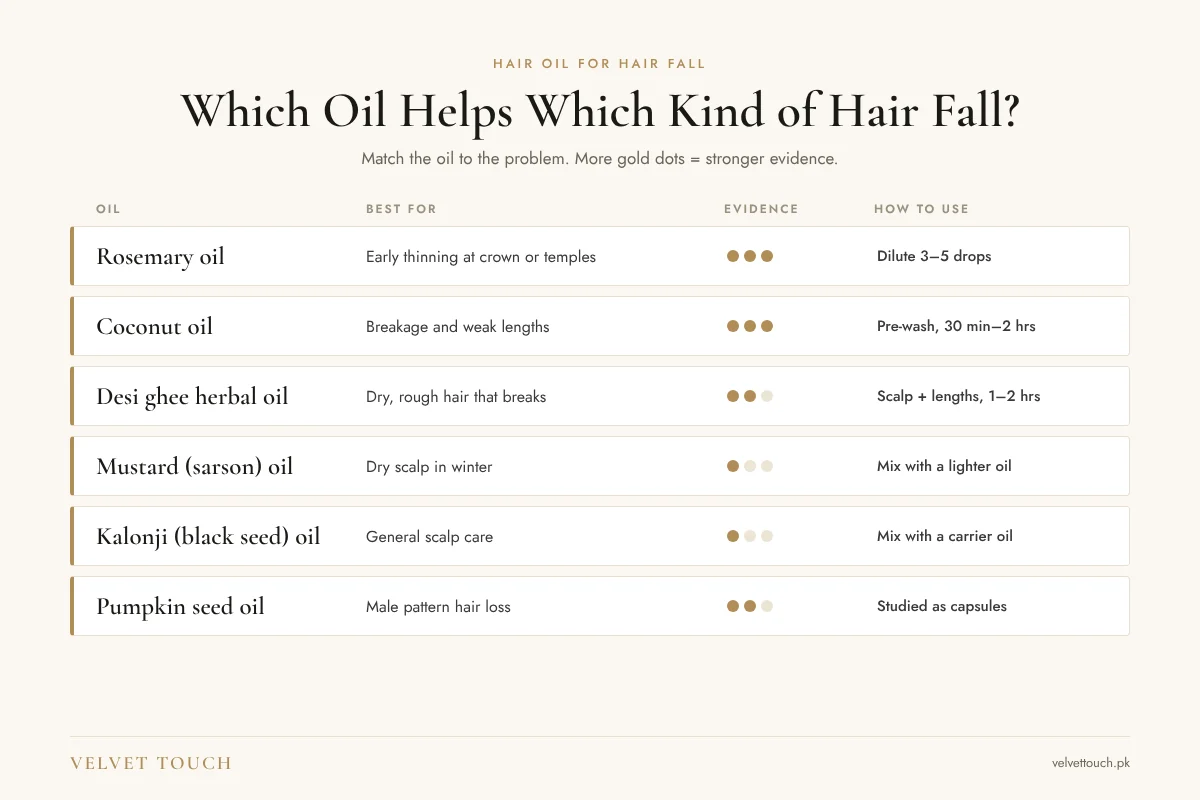
| Oil | Best for | Evidence | How to use |
|---|---|---|---|
| Rosemary oil | Early thinning at the crown or temples | Good: one human trial vs minoxidil | 3–5 drops in a carrier oil, on the scalp |
| Coconut oil | Breakage, weak and damaged lengths | Good lab evidence for less protein loss | Pre-wash, 30 min to 2 hours |
| Desi ghee herbal oil (amla, bhringraj, brahmi) | Dry, rough hair that breaks easily | Traditional use, limited trials | Scalp and lengths, 1–2 hours |
| Mustard (sarson) oil | Dry scalp in winter | Traditional use, no strong trials | Mix with a lighter oil, patch test first |
| Kalonji (black seed) oil | General scalp care | Small early studies only | Mix with a carrier oil |
| Pumpkin seed oil | Pattern hair loss in men | Promising, but the best study used capsules | Ask a doctor about oral use |
First, Find Out Why Your Hair Is Falling
Hair fall is not one problem. It is a sign, and the right fix depends on the cause. Before you buy any oil, spend one minute checking what kind of hair fall you have.
How much hair fall is normal?
According to the American Academy of Dermatology, most people shed 50 to 100 hairs a day. On the day you wash or comb out oiled hair, you may see more, because hairs that were already loose come out together. That alone is not a problem.
Hair fall needs attention when you notice any of these: hair coming out in clumps, a parting that looks wider than before, a thinner ponytail, a receding hairline, or round bald patches.
The 60-second hair test: shedding or breakage?
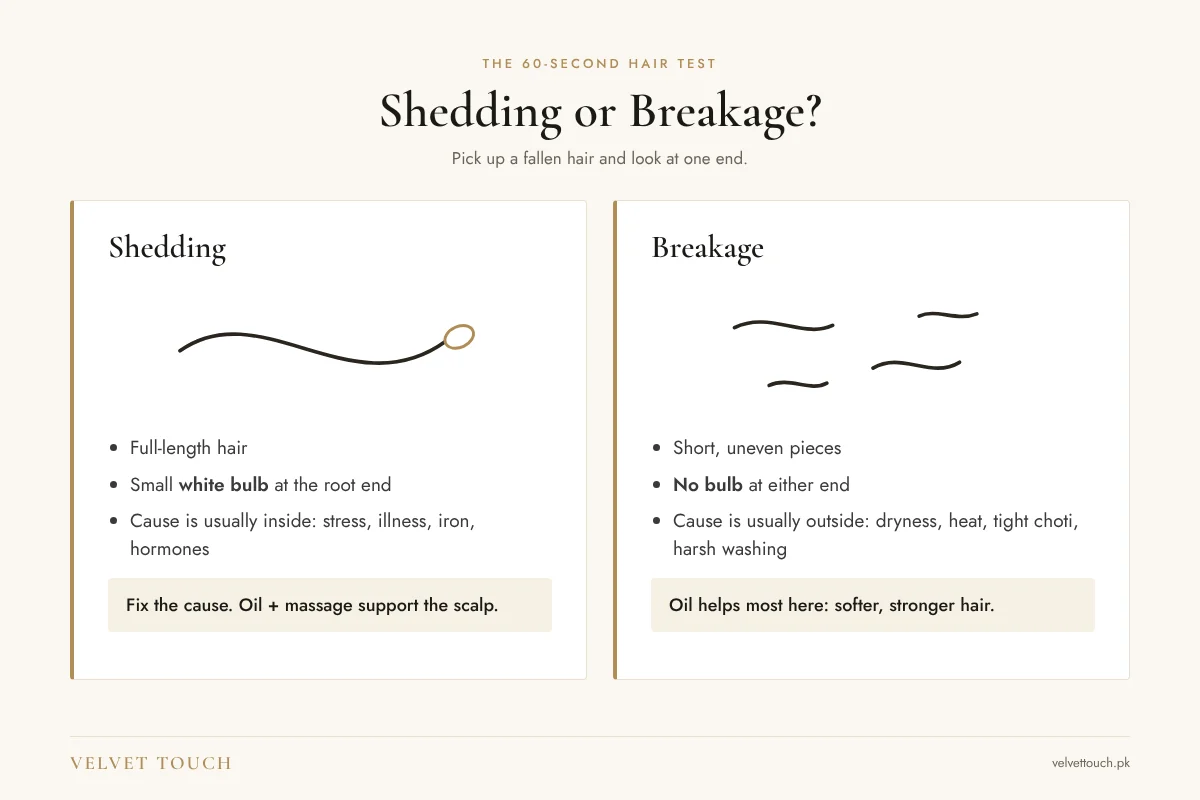
Pick up a few fallen hairs from your pillow, comb or bathroom floor and look closely at one end.
- Small white bulb at one end, full length: this is shedding. The hair came out from the root. The cause is usually inside the body: stress, illness, hormones, diet or genetics.
- No bulb, short or uneven pieces: this is breakage. The hair snapped along the length. The cause is usually dryness, heat, harsh washing, tight hairstyles or chemical treatments.
Oil helps breakage the most, because it softens the hair and reduces friction. For shedding, oil and scalp massage can support the scalp, but you also need to fix the cause.
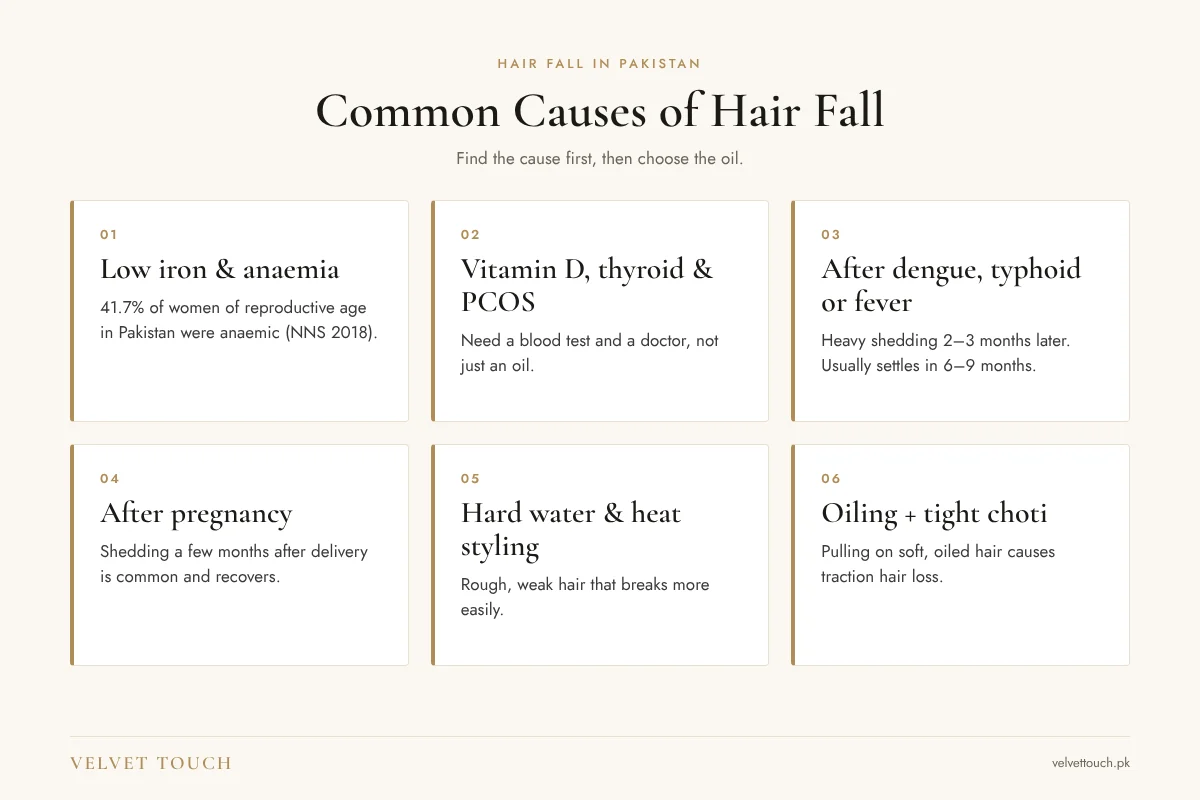
Common Causes of Hair Fall in Pakistan
Some causes of hair fall are more common here because of diet, weather, water and lifestyle. If one of these sounds like you, deal with it alongside your oil routine.
Low iron and anaemia
Iron deficiency is one of the most common reasons for diffuse hair shedding in women. In Pakistan, the National Nutrition Survey 2018 found that 41.7% of women of reproductive age were anaemic. Heavy periods, pregnancy and diets low in meat or lentils all raise the risk. A simple CBC and ferritin test can tell you where you stand.
Low vitamin D, thyroid problems and PCOS
Many people in Pakistan stay indoors or covered and get little sun, so low vitamin D is common. Thyroid problems (both underactive and overactive) and PCOS can also cause thinning. PCOS often shows as thinning at the top of the head along with irregular periods, acne or extra facial hair. These need a doctor, not just an oil.
Hair fall after dengue, typhoid, COVID or a high fever
A high fever or serious illness can push many hairs into the resting phase at once. About 2 to 3 months later, they shed together. This is called telogen effluvium. It looks scary, but it usually settles by itself within 6 to 9 months once your body recovers. Gentle care and oiling for breakage help you keep the hair you have while new hair grows back.
After pregnancy
Many new mothers notice heavy shedding a few months after delivery. Pregnancy hormones keep hair in the growing phase, and after birth that extra hair sheds. It is normal and usually recovers within a year. Keep your iron and protein up, especially if you are breastfeeding.
Hard water, heat and tight hairstyles
Hard water in cities like Lahore and Karachi can leave mineral build-up that makes hair rough and more likely to break. Daily straightening, hot blow-drying and colouring weaken the hair shaft too. And the classic habit of oiling hair and then tying it into a tight choti pulls on the roots. Over time, that pulling can cause traction hair loss at the temples and hairline.
Seasonal shedding
Many people notice more hair fall at the end of summer and into autumn. This seasonal shedding is usually mild and passes in a few weeks.
Male and female pattern hair loss
If your hairline is slowly receding, your crown is thinning, or your parting is widening year after year, it may be genetic pattern hair loss. This is where rosemary oil has some evidence, but medical treatment from a dermatologist works best, especially if you start early.
6 Hair Oils for Hair Fall: What Each One Actually Does
Below are the oils people in Pakistan reach for most when they want a hair oil for hair fall, with an honest look at what each one can and cannot do.
1. Rosemary oil: best evidence for thinning
Rosemary oil is the most researched oil for hair loss. In a 2015 randomised trial, people with pattern hair loss used either rosemary oil or 2% minoxidil for six months. Both groups had a similar rise in hair count at six months, and the rosemary group had less scalp itching. Nothing changed much at three months, so patience matters.
How to use it: rosemary is an essential oil, so never put it on your scalp undiluted. Mix 3 to 5 drops into a tablespoon of a carrier oil (coconut, almond, or a ready-made blend) and massage it into the scalp. Do a patch test behind your ear first.
2. Coconut oil: best for breakage
Coconut oil is small enough to soak into the hair shaft. a lab study in the journal of cosmetic science found it was the only one of three oils tested (with sunflower and mineral oil) that reduced protein loss from both healthy and damaged hair when used before and after washing. Less protein loss means stronger hair that breaks less.
How to use it: apply to the lengths and ends 30 minutes to 2 hours before you shampoo. In winter, warm the bottle in a bowl of hot water, because coconut oil sets solid in the cold.
3. Desi ghee herbal oil: for dry, rough hair that breaks
Desi ghee is rich in fats that coat and soften dry hair. Traditional blends add herbs like amla, bhringraj, brahmi, reetha and shikakai, which have been used in South Asian hair care for generations. Strong clinical trials on these herbs are still limited, so think of them as conditioning and scalp care, not a medical cure. If your hair fall is mostly breakage from dry, frizzy hair, this type of oil fits well. Read more in our guide to desi ghee for hair.
4. Mustard (sarson) oil: warm, but can irritate
Sarson ka tel is a household favourite, especially in winter. It is thick and conditioning, and many people like the warm feeling it gives during massage. There is no strong research showing it reduces hair fall, and it can irritate sensitive scalps. If you use it, mix it with a lighter oil and patch test first. We compare it in detail in desi ghee vs coconut oil vs mustard oil.
5. Kalonji (black seed) oil: promising, not proven
Kalonji oil appears in many hair fall oils in Pakistan. Some small early studies suggest it may support the scalp, but the evidence is not strong enough yet to call it a hair fall treatment. It is safe for most people when mixed with a carrier oil.
6. Pumpkin seed oil: mainly for male pattern hair loss
In a 24-week trial in men with pattern hair loss, those who took pumpkin seed oil capsules saw about a 40% rise in hair count, compared with about 10% on placebo. Note that this was oral capsules, not oil on the scalp. Speak to a doctor before you take any supplement.
What about onion oil and castor oil?
Onion is popular in hair fall oils, but the study people quote used raw onion juice on patchy hair loss, not onion oil. Castor oil is very thick and good at sealing in moisture, but there is no good human study showing it grows hair. Both are fine to use if you like them; just do not expect miracles.
If your main goal is longer, thicker hair rather than stopping hair fall, read our guide to the best oil for hair growth.
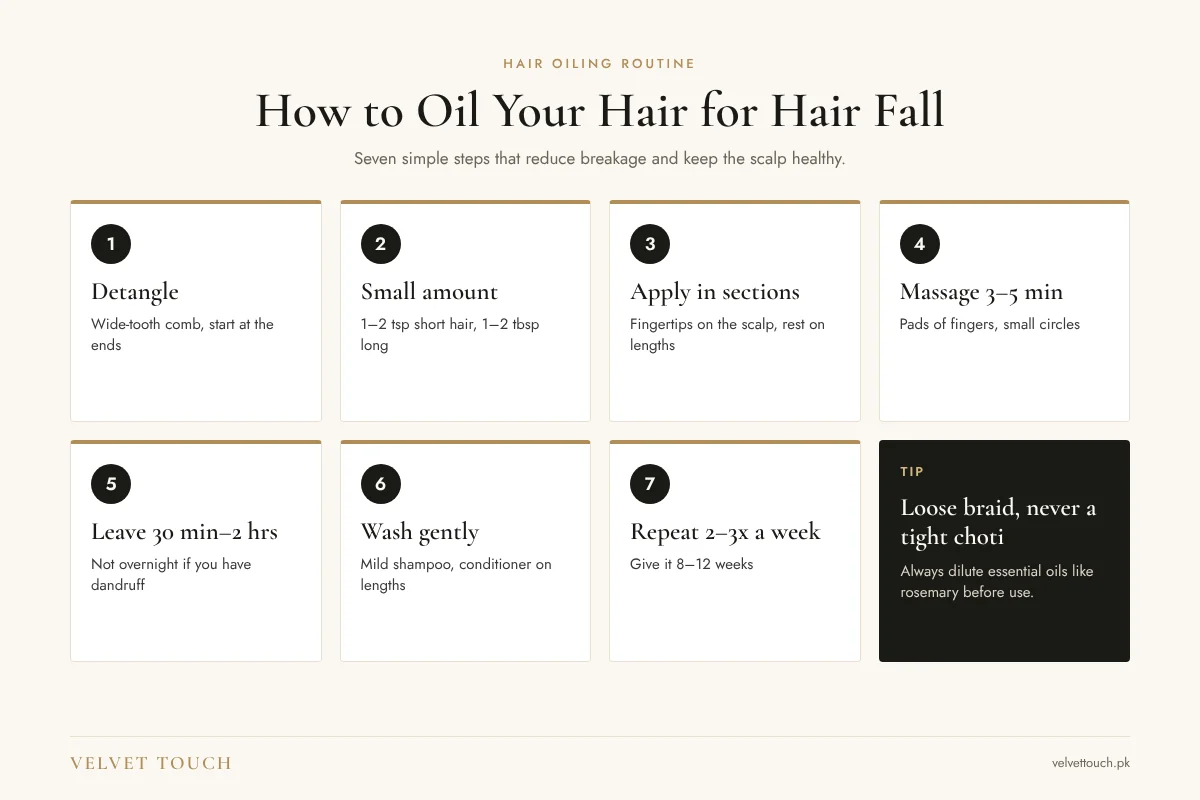
How to Use Hair Oil for Hair Fall (Step by Step)
The way you oil matters as much as the oil you pick. These steps reduce breakage and keep your scalp healthy.
- Detangle first. Gently detangle dry hair with a wide-tooth comb, starting from the ends. Pulling a fine comb through tangled, oiled hair causes breakage.
- Use a small amount. Take 1 to 2 teaspoons of oil for short hair and 1 to 2 tablespoons for long hair. More oil does not mean better results; it only means more shampoo.
- Apply in sections. Part your hair into 4 to 6 sections and apply oil to the scalp with your fingertips, then smooth what is left over the lengths and ends.
- Massage for 3 to 5 minutes. Use the pads of your fingers, not your nails, and move in small circles. Do not rub hard. Gentle massage relaxes the scalp and spreads the oil.
- Leave it on for 30 minutes to 2 hours. This is enough time for the oil to soften the hair. If you have dandruff or an oily scalp, do not leave oil on overnight.
- Wash with a mild shampoo. Shampoo the scalp twice if needed, then use conditioner on the lengths only. Pat dry with a soft towel or cotton T-shirt instead of rubbing.
- Repeat 2 to 3 times a week. Stay consistent for at least 8 to 12 weeks. Take a photo of your parting on day one so you can compare honestly.
Scalp massage on its own may help too. In a small Japanese study, men who had a 4-minute scalp massage every day for 24 weeks had slightly thicker hair at the end. It was a very small study, but massage is free and safe. When you shampoo, choose a mild shampoo and follow with conditioner on the lengths.
Hair Oiling Mistakes That Make Hair Fall Worse
- Oiling and then tying a tight choti or bun. Oil softens hair, and tight pulling on soft hair causes breakage and traction hair loss. Tie a loose braid instead.
- Leaving oil on overnight with dandruff. The yeast linked to dandruff feeds on oils. If you have flakes or itching, wash the oil out within 1 to 2 hours.
- Using too much oil. Heavy oil needs repeated shampooing to remove, and the extra washing and rubbing can cause more breakage.
- Putting pure essential oils on the scalp. Rosemary, tea tree and peppermint oils must be diluted. Used neat, they can burn and irritate.
- Rubbing hard with fingernails. Scratching damages the scalp. Use fingertips and light pressure.
- Switching oils every two weeks. Hair grows slowly. No oil can show its effect in 10 days.
- Ignoring the real cause. If you are low on iron or have a thyroid problem, oil alone will not stop the shedding.
Food and Habits That Support Your Oil Routine
Hair is made of protein, and it needs iron, zinc and vitamins to grow well. These everyday Pakistani foods help:
- Protein: eggs, daal, chanay, chicken, fish, yoghurt and doodh.
- Iron: red meat, keema, kaleji, palak, kala chana and lobia. Eat them with something rich in vitamin C, like lemon or kinnow, to absorb more iron.
- Vitamin D: 15 to 20 minutes of morning sun on your arms and face a few times a week, plus eggs and fish.
- Healthy fats: walnuts, almonds and alsi (flax seeds).
Sleep, stress and crash diets matter too. Losing weight very fast is a common trigger for shedding a few months later.
Many people also ask about multivitamins such as zinc or biotin tablets. These help mainly if you are actually low in that nutrient. Get a blood test first and take supplements on a doctor’s advice, because too much of some vitamins can make hair fall worse.
A Simple 12-Week Hair Fall Routine
Any hair oil for hair fall needs time, because hair grows in slow cycles. Use this plan to stay consistent and to know what to expect.
| Weeks | What to do | What to expect |
|---|---|---|
| 1–4 | Oil 2–3 times a week, massage 3–5 min, mild shampoo, loose braids, no heat styling. Book a blood test if shedding is heavy. | Softer hair, less breakage when combing. Shedding may look the same. |
| 5–8 | Keep the routine. Add rosemary (diluted) if you see thinning at the crown or temples. Fix any deficiency your doctor finds. | Fewer broken pieces on the comb and pillow. |
| 9–12 | Stay consistent. Compare your day-one parting photo in the same light. | Shedding starts to settle if the cause is under control. Baby hairs may appear. |
When Oil Is Not Enough: See a Dermatologist If…
- You have round bald patches or patches with broken hairs.
- Hair is coming out in clumps for more than 3 months.
- Your hairline is receding or your parting is widening quickly.
- Your scalp is red, painful, scaly, or has pus bumps.
- Hair fall comes with tiredness, weight change, irregular periods, acne or extra facial hair.
- Hair fall started after a new medicine.
Early treatment gives the best results, especially for pattern hair loss and alopecia areata. Oil can stay part of your routine alongside medical care.
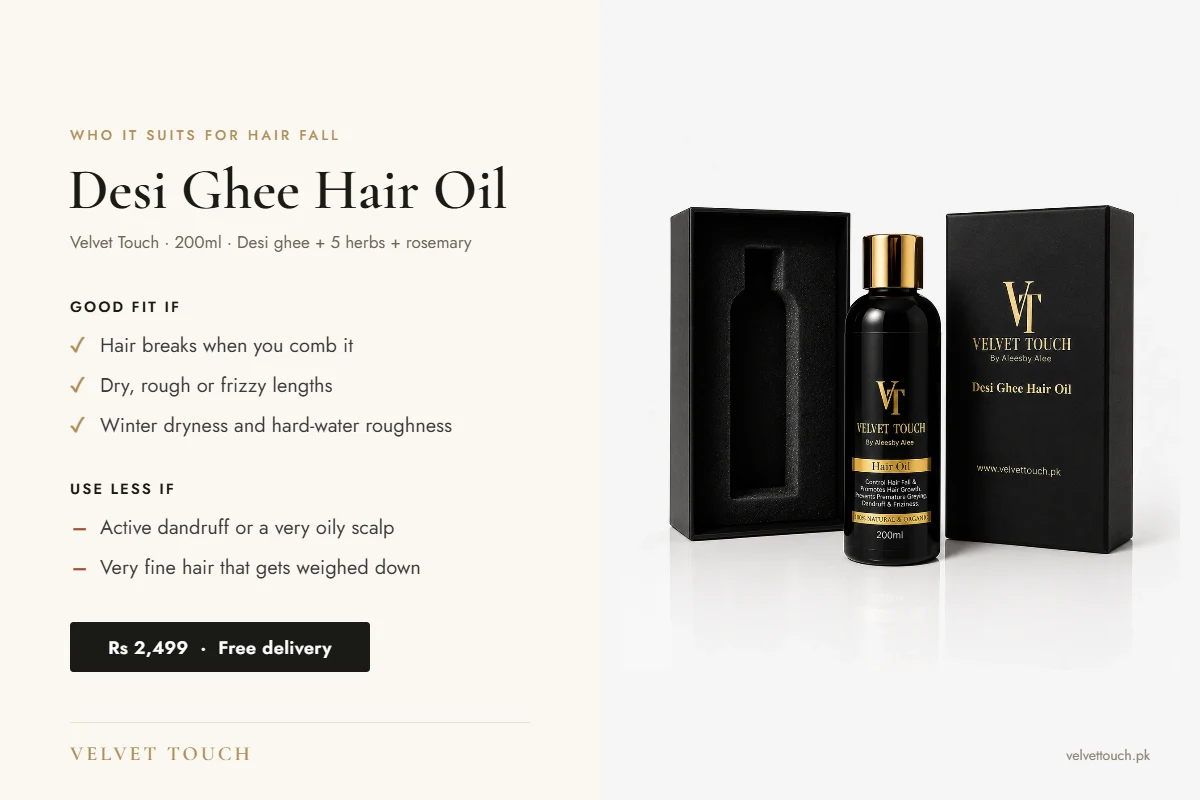
Is Velvet Touch Desi Ghee Hair Oil Good for Hair Fall?
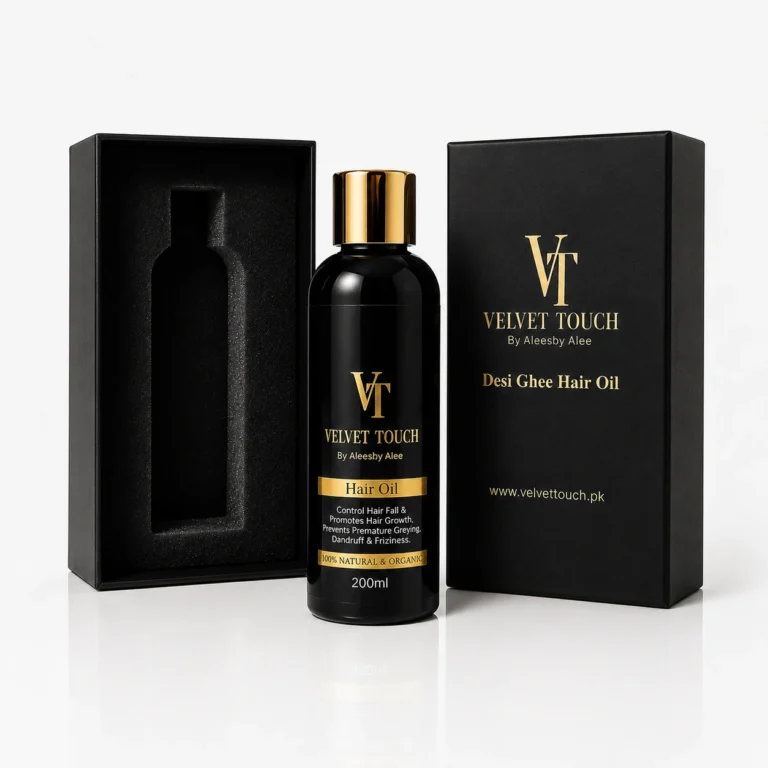
Velvet Touch Desi Ghee Hair Oil is made for dry, rough and dull hair, which is where a lot of everyday hair fall from breakage starts. It blends pure desi ghee with amla, reetha, shikakai, brahmi and bhringraj, plus 7 essential oils including rosemary, lavender and tea tree.
- Good fit if: your hair breaks when you comb it, feels dry and rough, or gets frizzy in winter or with hard water.
- Use less if: your scalp gets oily quickly, you have active dandruff, or your hair is very fine and gets weighed down.
- Not a medical treatment: if your hair fall is from iron deficiency, thyroid, PCOS or pattern hair loss, use it for hair care alongside your doctor’s plan.
It comes in a 200ml bottle for Rs 2,499 with free delivery across Pakistan and cash on delivery. If you want a full routine, the Hair Care Kit includes shampoo, conditioner, hair serum and the Desi Ghee Hair Oil together for Rs 5,999. See our shipping and return policy for details, or browse the full hair care range.
Frequently Asked Questions
Which oil is best for hair fall in Pakistan?
It depends on the cause. For breakage and dry hair, coconut oil or a desi ghee herbal oil works well. For early thinning at the crown or temples, rosemary oil diluted in a carrier oil has the best evidence. For shedding from low iron, thyroid problems or illness, treat the cause first.
Which oil stops hair fall immediately?
No oil stops hair fall immediately. Hair grows in cycles, so even a good routine takes 8 to 12 weeks to show a clear change. Oil can reduce breakage within a few weeks, but shedding from the root needs time and the right treatment.
Can hair oil regrow lost hair?
Oil cannot bring back hair follicles that are gone. Rosemary oil has shown regrowth similar to 2% minoxidil in early pattern hair loss in one trial. For bald patches or advanced thinning, see a dermatologist.
How many times a week should I oil my hair for hair fall?
Two to three times a week is enough for most people using a hair oil for hair fall. Daily oiling usually means daily shampooing, which can cause more breakage. If you have an oily scalp or dandruff, once or twice a week is better.
Should I leave oil in my hair overnight?
If your scalp is healthy and dry, overnight oiling is fine now and then. If you have dandruff, itching or an oily scalp, wash the oil out within 1 to 2 hours, because oil left too long can make dandruff worse.
Is rosemary oil better than onion oil for hair fall?
Rosemary oil has better evidence. It was compared with 2% minoxidil in a six-month human trial. The well-known onion study used raw onion juice on patchy hair loss, not onion oil.
Is hair fall after dengue or typhoid permanent?
Usually not. Heavy shedding 2 to 3 months after a high fever is called telogen effluvium, and it normally settles within 6 to 9 months. Eat well, check your iron, and be gentle with your hair while it recovers.
Do vitamin tablets stop hair fall?
Only if you are low in a nutrient. Iron, vitamin D, zinc and B12 deficiencies can cause shedding, and fixing them helps. Taking supplements without a deficiency usually does nothing, and some vitamins in excess can cause hair fall. Get a blood test first.
Baal girne se rokne ke liye kaunsa tel behtar hai?
Agar baal toot rahe hain to coconut oil ya desi ghee wala herbal tel achha hai. Agar baal patle ho rahe hain to rosemary oil ko kisi carrier oil mein mila kar lagayein. Hafte mein 2 se 3 baar tel lagayein, halka massage karein, aur agar 3 mahine se zyada baal gir rahe hon to doctor se blood test karwayein.
Conclusion
The right hair oil for hair fall can make a real difference, but only when it matches the problem. Use coconut or a desi ghee herbal oil for breakage, diluted rosemary oil for early thinning, and oil gently 2 to 3 times a week for at least 8 to 12 weeks. If your hair is shedding from the root, find the cause with a doctor and a blood test, and let oil support your hair while it recovers. Still unsure which oil suits you? Start with our guide to the best hair oil in Pakistan for your hair type, or see our tips on hair oil for dry hair.
Ready to Build a Gentle Hair Fall Routine?
Try Velvet Touch Desi Ghee Hair Oil: desi ghee, five traditional herbs and rosemary in one 200ml bottle, with free delivery and cash on delivery all over Pakistan.
Sources
- American Academy of Dermatology: Do you have hair loss or hair shedding?
- Panahi Y, et al. Rosemary oil vs minoxidil 2% for androgenetic alopecia. Skinmed, 2015.
- Rele AS, Mohile RB. Effect of mineral oil, sunflower oil, and coconut oil on prevention of hair damage. J Cosmet Sci, 2003.
- Cho YH, et al. Pumpkin seed oil in men with androgenetic alopecia. Evid Based Complement Alternat Med, 2014.
- Koyama T, et al. Standardized scalp massage results in increased hair thickness. Eplasty, 2016.
- Iron deficiency anaemia among women in Pakistan: National Nutrition Survey 2018.
This article is for general information and is not medical advice. If you have heavy or sudden hair loss, please consult a qualified dermatologist.