Desi Ghee vs Coconut Oil vs Mustard Oil for Hair: Which Is Better?

Desi ghee, coconut oil (nariyal tel) and mustard oil (sarson ka tel) are the three oils most Pakistani families have used for hair oiling for generations. Short answer: coconut oil is the best all-rounder for reducing breakage, desi ghee is the richest option for very dry, rough and frizzy hair, and mustard oil suits people who like a warming scalp massage and do not have a sensitive scalp. None of the three is proven to regrow hair, so the best choice depends on your hair type, your scalp and the season.
Most articles online compare only two of these oils, or repeat claims like “mustard oil turns grey hair black” without saying what is actually known. This guide compares all three side by side, separates research from tradition, and tells you which oil to pick for hair fall, dandruff, dry hair and Pakistani weather.
Quick Comparison: Desi Ghee vs Coconut Oil vs Mustard Oil
| Feature | Desi Ghee | Coconut Oil | Mustard Oil |
|---|---|---|---|
| Texture | Very rich, semi-solid | Light to medium; solid below about 24°C | Thick and sticky |
| Main fats | Saturated fats, butyric acid, vitamins A, D, E, K | Lauric acid (medium-chain) | Erucic and oleic acid, omega-3 (ALA) |
| Gets inside the hair shaft? | Mostly coats the surface | Yes, the best-studied for this | Mostly coats the surface |
| Best for | Very dry, rough, frizzy lengths and split ends | Breakage, damaged or coloured hair, regular pre-wash oiling | Scalp massage for normal-to-oily scalps, thick hair |
| Smell | Buttery; can linger | Mild, pleasant | Strong and pungent |
| Washes out | Hard; needs 2 shampoos | Easy | Medium to hard |
| Watch out for | Buildup, greasy scalp | Stiff feel in some hair types | Scalp irritation; always patch test |
| Best season in Pakistan | Winter | All year (warm it in winter) | Winter |
Desi Ghee for Hair: Benefits and Limits
Desi ghee is clarified butter. It is made almost entirely of fat, including saturated fats and small amounts of fat-soluble vitamins A, D, E and K. On hair, it works as an occlusive, which means it forms a soft layer on the hair that slows down moisture loss. That is why many people find their hair feels smoother and less frizzy after a ghee treatment.
What desi ghee is good for
- Softening very dry, rough or brittle hair lengths
- Taming frizz and flyaways, especially in dry winter air
- Smoothing split ends so they look less frayed (it cannot repair them)
- Adding shine to dull, dry-looking hair
Limits of desi ghee
- There are no clinical studies showing ghee makes hair grow faster or stops hair fall.
- Kitchen ghee is heavy and hard to wash out, and it can leave a smell.
- On an oily or dandruff-prone scalp it can add to buildup and greasiness.
For a full routine, including ghee hair masks and side effects, read our guide on desi ghee for hair.
Coconut Oil for Hair: Benefits and Limits
Coconut oil is the most researched of the three. Its main fat, lauric acid, has a small, straight molecule that can get inside the hair shaft instead of only coating it. In a well-known 2003 study in the Journal of Cosmetic Science, coconut oil reduced protein loss from both damaged and undamaged hair when used before and after washing. Mineral oil and sunflower oil did not show the same effect.
What coconut oil is good for
- Reducing breakage from combing, heat styling and washing
- Protecting chemically treated, coloured or rebonded hair
- Pre-wash oiling (champi) 30 minutes to a few hours before shampoo
- Light, regular use: it washes out more easily than ghee or mustard oil
Limits of coconut oil
- It turns solid in cold rooms, so in a Lahore or Islamabad winter you need to warm it first.
- Some people, often with coarse or low-porosity hair, find it leaves hair stiff or straw-like.
- It is not a proven hair growth treatment.
Mustard Oil for Hair: Benefits and Limits
Mustard oil is thick and has a strong, sharp smell that comes from a natural compound called allyl isothiocyanate. It contains monounsaturated fats such as erucic and oleic acid, plus some omega-3. In South Asian homes it is usually warmed and massaged into the scalp, often in winter.
What mustard oil is good for
- A warming scalp massage that many people find relaxing
- Coating thick, coarse hair to reduce dryness and tangles
- Adding weight to hair that feels light and flyaway
Limits of mustard oil
- The same compound that gives it the sharp smell can irritate or redden sensitive skin. Always do a patch test.
- Claims that mustard oil darkens grey hair or doubles hair growth are not backed by research.
- The strong smell stays in hair and on pillow covers.
Which Oil Is Best for Hair Growth?
The honest answer is that none of these three oils is proven to make hair grow. Hair growth is driven mostly by genes, hormones, diet, stress and health conditions. What oiling can do is reduce breakage, so you keep more of the length you grow, and make hair look thicker and healthier.
For a deeper look at rosemary, castor, onion and other popular oils, see our guide to the best oil for hair growth.
The scalp massage itself may help a little. A small 2016 study found that daily 4-minute scalp massage for 24 weeks increased hair thickness in healthy men. So the habit of champi may matter as much as the oil you choose.
If you want to support length and reduce breakage, coconut oil has the best evidence. If your hair breaks because it is very dry, desi ghee on the lengths can help.
Which Oil Is Best for Hair Fall?
Most “hair fall” people notice at home is actually breakage: short broken pieces from dry, weak hair. For that, coconut oil (to reduce protein loss) or desi ghee (to soften very dry ends) both help. If you are losing hair from the root, in clumps or in patches, oil will not fix it. See a dermatologist to check for causes like iron deficiency, thyroid problems or hormonal hair loss.
Which Oil Is Best for Dandruff?
Be careful here. Dandruff is linked to a yeast called Malassezia that feeds on oils on the scalp, so leaving heavy oil on a flaky scalp overnight can make dandruff worse for some people. Desi ghee is the riskiest of the three for a dandruff-prone scalp. Coconut oil is lighter, and mustard oil has some antimicrobial properties in lab studies, but neither replaces an anti-dandruff shampoo. If you have dandruff, oil only your lengths, or wash oil off the scalp within an hour or two.
Which Oil Is Best for Your Hair Type?
| Your hair or scalp | Best choice | How to use it |
|---|---|---|
| Very dry, rough, frizzy hair | Desi ghee or a ghee-based hair oil | Mid-lengths to ends, 1 to 2 hours before washing |
| Damaged, coloured or rebonded hair | Coconut oil | Pre-wash, 2 to 3 times a week |
| Fine or thin hair | Coconut oil, very little | Ends only, wash out the same day |
| Thick, coarse, curly hair | Desi ghee or mustard oil | Lengths, can be left in longer |
| Oily scalp | Coconut oil on lengths only | Avoid heavy oil on the scalp |
| Dandruff or itchy scalp | Light coconut oil on lengths | Do not leave oil on the scalp overnight |
| Sensitive scalp | Coconut oil or ghee | Avoid mustard oil, or patch test first |
Best Oil for Pakistani Weather
Pakistan’s climate changes a lot by city and season, and that should change your oil:
- Humid summers (Karachi, Lahore monsoon): choose lighter coconut oil and wash it out the same day. Heavy ghee or mustard oil in sticky weather often leaves hair greasy and attracts dust.
- Dry winters (Lahore, Islamabad, Peshawar, Quetta): this is when desi ghee and mustard oil shine. Cold, dry air pulls moisture from hair, and richer oils help lock it in.
- Hard water areas: hard water can leave hair rough and dull. A pre-wash oil helps protect hair from that rough feeling.
Can You Mix Desi Ghee, Coconut Oil and Mustard Oil?
Yes, and many people get better results this way. A mix gives you the softness of ghee, the breakage protection of coconut oil and a lighter feel than ghee alone. A simple home mix:
- 1 teaspoon desi ghee
- 2 teaspoons coconut oil
- 1 teaspoon mustard oil (skip this if your scalp is sensitive)
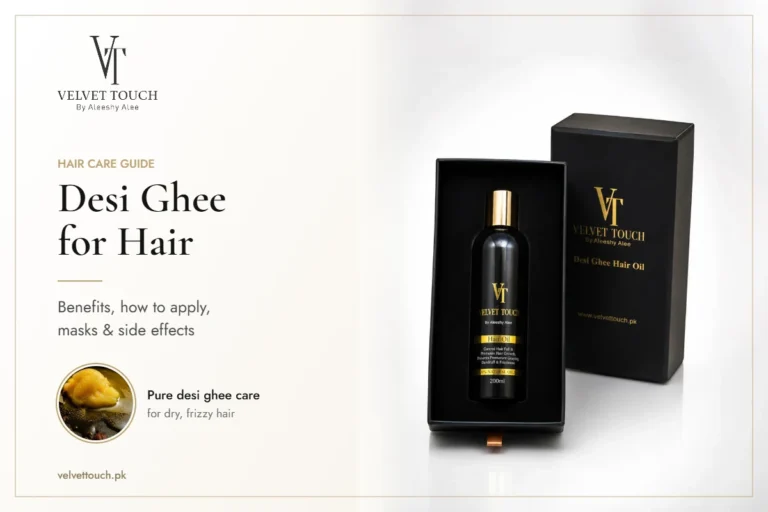
Warm gently, mix well and apply to the lengths. If you prefer a ready-made option, the Desi Ghee Hair Oil by Velvet Touch combines desi ghee with herbs like amla, bhringraj and brahmi in an oil that is easier to spread and wash out than kitchen ghee.
How to Apply Hair Oil the Right Way
- Warm it slightly. Place the bowl in warm water. Never make oil hot, and test it on your wrist first.
- Start with dry, detangled hair. Section it into 4 parts.
- Use a small amount. About 1 to 2 teaspoons for shoulder-length hair is enough.
- Massage the scalp gently with your fingertips for 3 to 5 minutes, unless you have dandruff.
- Focus on the lengths and ends, where hair is oldest and driest.
- Leave it on for 1 to 2 hours, or overnight only if your scalp is not oily or flaky.
- Wash out with shampoo, twice if needed, then use conditioner on the lengths.
For washing out heavy oils, a gentle hair shampoo followed by a hair conditioner keeps hair clean without stripping it. A few drops of hair serum on damp ends helps control frizz between oiling days.
How Often Should You Oil Your Hair?
- Dry or damaged hair: 2 to 3 times a week
- Normal hair: 1 to 2 times a week
- Oily scalp or dandruff: once a week, lengths only
Mistakes to Avoid
- Using too much oil, then shampooing 3 or 4 times to get it out
- Leaving heavy oil on a dandruff-prone scalp overnight
- Tying oiled hair in a tight bun, which can pull and break hair
- Using mustard oil without a patch test
- Expecting any oil to stop genetic or hormonal hair loss
Verdict: Which Is Better for Hair?
- Choose coconut oil if you want the best-researched oil for breakage and regular pre-wash use.
- Choose desi ghee if your hair is very dry, rough or frizzy, especially in winter.
- Choose mustard oil if you enjoy a warming scalp massage and your scalp is not sensitive.
- Choose a blend if you want softness and protection without heavy buildup.
Still not sure which oil suits you? Read our guides to the best hair oil in Pakistan and hair oil for dry hair, or try our Hair Care Kit for a complete routine. All orders get free delivery all over Pakistan with cash on delivery.
Frequently Asked Questions
Is desi ghee better than coconut oil for hair?
Not overall. Coconut oil has better evidence for reducing breakage and protein loss. Desi ghee is better for softening very dry, rough or frizzy hair. Many people use coconut oil regularly and ghee as a weekly treatment.
Which is better for hair growth, mustard oil or coconut oil?
Neither is proven to grow hair. Coconut oil is better at reducing breakage, which helps you keep length. Mustard oil is mostly used for a warming scalp massage.
Can I apply desi ghee on my hair overnight?
Yes, if your scalp is not oily or prone to dandruff. Apply it mainly to the lengths, cover your pillow and wash it out the next morning with shampoo.
Does mustard oil turn grey hair black?
There is no scientific evidence that mustard oil reverses grey hair. Greying is mainly genetic and age-related.
Can I mix desi ghee and mustard oil for hair?
Yes. Mixing ghee with a lighter oil makes it easier to spread and wash out. Patch test mustard oil first if your skin is sensitive.
Which oil is best for hair in winter?
Desi ghee and mustard oil work well in dry winter weather. Coconut oil can be used too, but warm it first because it turns solid in the cold.
How do I remove the ghee smell from my hair?
Shampoo twice, focusing on the lengths, then condition. Using a small amount of ghee mixed with coconut oil also reduces the smell.
This article is for general hair care information. If you have sudden hair loss, patchy bald spots or a painful scalp, please see a dermatologist.